Sunday, September 1, 2019

Secrets of Blackmoor Documentary


I ended the month of August by streaming Secrets of Blackmoor, the 2019 documentary by Chris Graves and Griffin Mon Morgan III about Dave Arneson, the Twin Cities gaming scene, and the prehistory of roleplaying games. It was a pleasure to see and hear the people behind so many of the stories I've read—and I would love to have Dave Wesely as my game master. At the same time (and this may be a result of my turning 50 back on August 20th), I found watching the documentary a very bittersweet experience: two members of the Blackmoor group—Duane Jenkins and Pete Gaylord, respectively the first vampire and the first magic-user in RPGs—have passed away since being interviewed for the film. It's a mitzvah that Graves and Morgan got these men and women on film to talk about how they created the hobby we all love, and I definitely recommend watching Secrets when you get a chance.

P. S. Gary Gygax certainly gets a bit of stick toward the start of the documentary, but that quickly gives way to a celebration of Arneson and his friends.

Friday, August 23, 2019

[OSE] Advanced Fantasy PDFs Released


Today Necrotic Gnome released PDFs of the first Advanced Fantasy books in its Old School Essentials line: Advanced Fantasy Genre Rules and Advanced Fantasy Druid and Illusionist Spells. These books effectively B/X-ize material from the AD&D Player's Handbook and Unearthed Arcana volumes(I don't really have to say "advanced version of the original fantasy roleplaying game," do I?) In the case of Advanced Fantasy Genre Rules, that means new human classes (acrobat, assassin, barbarian, bard, druid, illusionist, knight, paladin, ranger), new demi-human classes (drow, duergar, gnome, half-elf, half-orc, svirfneblin), poison rules, and other rules new to B/X games (e.g., separating race from class, multi-classing, weapon specialization, etc.).


Advanced Fantasy Druid and Illusionist Spells is, well, it's a collection of spells for the Advanced Fantasy Genre Rules druids and illusionists to cast. But Necrotic Gnome has done a wonderful job of adapting the spells, and there's some particularly wonderful artwork to go along with the B/X translations of the AD&D spell entries.

Tuesday, August 20, 2019

50 Barbaric Birthdays


Fifty years ago today, I uttered my first barbaric yawp. Looking forward to another five decades of telling Crom to go to hell!

Saturday, August 17, 2019

A Difference between Gnomes and Dwarves


As someone who enjoys playing gnomes in D&D (and in fact assumed that the illustration on the title page of the first Player's Handbook depicted one), I always bristle when people complain that gnomes are lesser copies of dwarves. I recognize that the game hasn't always been good about leveraging what makes gnomes interesting as foils to dwarves, and I also agree with those who argue that halflings and gnomes in a campaign is one smaller-than-dwarf species too many. But a game that uses just gnomes can easily highlight the different niches gnomes and dwarves occupy.

Rather than talk about, say, tricksy gnomes and dour dwarves, I'd like to focus on the spaces the two species occupy. Over on the RPG Pub forum, Edgewise noted that "dwarves dig in rock and gnomes dig through soil," and I think that's a distinction with serious implications.

Gnomes live near the surface, burrowing in dirt. Their tunnels dodge tree roots and criss-cross with those of foxes and badgers. Gnome life is about interaction with living creatures, plants and animals and fungi. You delve around the trees instead of chopping them down to fuel the forges. It's difficult for a gnome to understand why dwarves want to surround themselves with dead stone.

The dwarves think that the gnomes are literally and figuratively shallow.

Friday, August 9, 2019

Ernie Colón (1931-2019)


The official Facebook page for comics artist Ernie Colón just announced that Ernie passed away yesterday after a struggle with cancer. Ernie's work on Arak, Son of Thunder (he co-created the character with Roy Thomas and pencilled the first twelve issues) was part and parcel of my early years in the tabletop RPG scene: Arak #1 was released in May 1981, ten months after I acquired the Eric Holmes Dungeons & Dragons boxed set. I don't think any Quontauka warriors showed up in my D&D games, but I do know that Colón's vision of a mythical Carolingian Europe was central to the way that I saw D&D in my mind's eye. His cover for Arak #8 (December 1981) is one of my favorite pieces of his as are his covers for #9 (January 1982) and #10 (February 1982). That was a great three-month run! Thanks for all the great comics work, Ernie! RIP.


Wednesday, July 24, 2019

The Illustrated Example of Play


The above image is a screenshot of p. 60 of Dreamscape Design's BLUEHOLME Journeymanne Rules, a retroclone of the 1977 J. Eric Holmes edition of Dungeons and Dragons. I recently purchased the Journeymanne Rules and, while I have yet to fully digest them, I thought that this lovely pairing of sample combat and illustration merited comment. Old school D&D has lots of wonderful examples of play (RIP Frederik and Black Dougal), but I don't recall ever seeing one accompanied by a step-by-step, correspoding illustration before. Kudos to Michael Thomas (the writer) and whichever of his artists came up with this pleasant surprise!

Monday, April 9, 2018

The Stupidity of Boob Armor


Because it's never a bad time to remind people how ridiculous boob armor really is ...

Monday, March 26, 2018

[Uncharted Worlds] Kylara Vatta


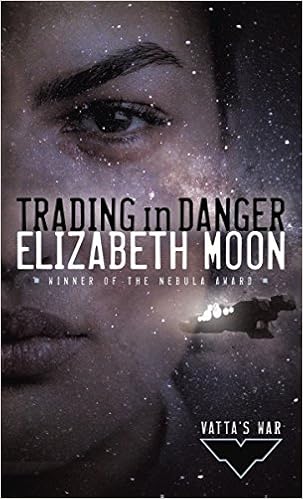
I'm currently blowing my way through Vatta's War, Elizabeth Moon's five-volume series about the adventures of Kylara "Ky" Vatta, Space Academy dropout and merchant trader scion. (This is so I can get up to speed before starting Cold Welcome, the first book in the new Vatta's Peace series.) I don't want to give away any spoilers, but I can say that the Ky Vatta who appears at the beginning of Trading in Danger (the first book in the series) is a perfect starting character for Uncharted Worlds (or pretty much any other SF RPG).

Vatta's home planet, Slotter Key, provides her with a Productive Origin. (Given the interstellar reputation of Vatta Enterprises, I considered giving her a Privileged Origin, but it's clear that Vattas are expected to work for a living, no matter how much money they may have inherited.) Vatta's not particularly intellectual, so "Education" is out as an Origin skill, and so is "Calibrations"—she's not much of a mechanic. "Acumen" is an obvious choice for a merchanter's child, but she'll be able to get that skill from her Commercial Career (see below). I'm therefore opting for "Vocation": Vatta could use the Expertise boost, and her hard-working nature justifies the choice.

Careers are a no-brainer: her parents raised her from infancy to be Commercial, and her contrary nature led her to the Slotter Key Space Academy and thus Military. Because Vatta never made it out of the Academy (she's kicked out for political reasons on p. 2 of Trading in Danger), one skill from Military should be enough, and "Authority" is the obvious pick here. As the plot of the novel will go on to make clear, Vatta may be a neophyte captain, but she knows how to command her crew. The remaining two skills a starting UW character gets will come from Commercial: "Marketing" (Vatta knows where to go to get what she needs) and the aforementioned "Acumen" (she knows how to read the market once she arrives).

Stats are also straightforward. Vatta puts her +2 in Mettle (courage under fire is her forte), one of her +1s in Physique (she is deceptively tough for her age and size), and the other +1 in Influence (she's certainly charismatic). Her 0 goes into Expertise, which is subsequently raised to a +1 courtesy of her "Vocation" Origin skill (she's not a genius, but she knows how to apply herself). Her -1 has to go into Interface: she's no hacker, even if she knows her way around an cerebral implant.

The mission she's given by her father (to deliver some goods in an aging hull en route to the scrapyard) is straightforward enough, so her Advancement trigger is "A cargo is exchanged." The clear choice for a Workspace is "Mercantile," but here Vatta's GM might intervene and make the space a bit less cushy (to reflect the decrepit condition of Vatta's ship, the Glynnis Jones).

Characters normally start play with a Class 0 Attire outfit, but Vatta's fashion-minded mother has made sure that she has a stylish Vatta Enterprises uniform (Class 1 Uniform, Impressive) as well. She also has her setting's ubiquitous cerebral implant (Class 1 Cybermod, Head, Implement-Broadcast Kit), allowing her to connect to local networks, transmitting and receiving information. Finally, her Class 2 asset is a top-of-the-line Deere Ltd. pressure suit (Class 1 Simple, Tough, Sealed).

It's always a good sign when a game system allows you to accurately translate the abilities and qualities of a fictional protagonist from a related genre, and that's certainly the case here with UW.


Tuesday, March 20, 2018

[Uncharted Worlds] Pets in SPAAAACE! Addendum


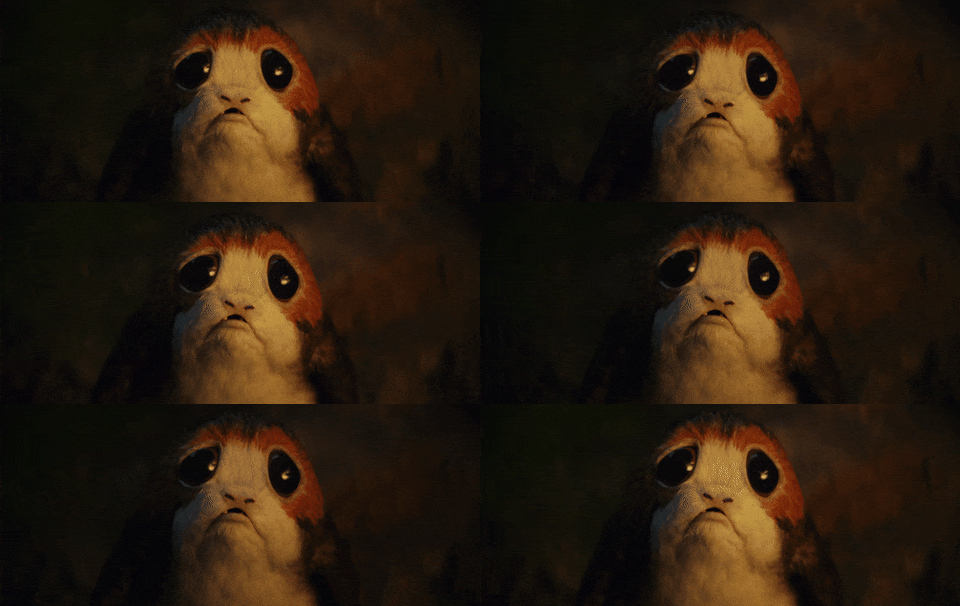
I can't believe I didn't stat up these little guys when I wrote the original "Pets in SPAAAACE!" post back in July 2017. I guess I didn't have the full Last Jedi fever at that point. Anyhoo, if you want to add porgs to your Uncharted Worlds game, their basic (Class 0) Beast chassis has Natural Locomotion (Flying) as a default. Movement (Swimming) is almost a mandatory upgrade, as is Tiny.


You may also want to give your porg the Emotional upgrade (although you can decide whether the mental state they exude is bliss or rage).

Friday, July 21, 2017

[Uncharted Worlds] Pets in SPAAAACE!


A few weeks back Sean Gomes released the long-awaited Far Beyond Humanity supplement for his Uncharted Worlds RPG. FBH contains—among other things—rules for adding not only extranormal powers to one's UW campaign but also alien player characters. I haven't had a chance to read over the book carefully, but I did find my eyes drawn to one page in particular: the page in the "Commercial" chapter on beast Assets.

Ever since I played a Dwarf Hunter in World of Warcraft, I've been obsessed with pets for characters.  (Well, it's possible that watching The Beastmaster all those years on TBS may also be responsible for this predilection.) For example, the lack of a good Beastmaster Ranger option in Fifth Edition Dungeons & Dragons is a major factor in my lack of enthusiasm for those rules. Conversely, the awesome Animal Companion and Pet rules in 13th Age made that game an easy sell for me (as shown here and here). So finally getting pet rules for UW (something I missed during Sean's open development process for the book) makes me happy.

I'm also happy because the rules for beast Assets allow me to recreate famous science fiction pets right out of the gate.


For example, Kitty Pryde's beloved space dragon Lockheed is a cinch to make: start with a Class 2 Asset beast chassis (basic ability + 2 upgrades), the sort of chassis you'd take if you were going to make a critter-centered PC. A beast Asset can have either Natural Weaponry (one upgrade from the Melee Weapons table) or Natural Locomotion (something other than just walking). I could give Lockheed the Energy upgrade to represent his fiery breath—or I could give him Flying as a form of locomotion. In this case, I'm going to go with Flying because I can also give Lockheed a beast upgrade of Deadly to get the Energy attack. For my second upgrade, I take Tiny; Lockheed is always perched on Kitty's shoulder.

And that's it!


Anne McCaffrey's fire lizards are just as easy to make as Lockheed. Replace Deadly with the upgrade Bond, allowing Beauty and the rest of her flight to telempathically communicate with Menolly. No other changes are needed.

Finally, it turns out that you can make this guy with the FBH beast Asset rules:


Start with Natural Weaponry (the Energy upgrade to represent his lightning Pokémon powers) for free, add the Attuned upgrade (so that Pikachu can't be hurt by the electricity he channels), and then finish him off with the Summoned upgrade ("Pikachu, I choose you!").

A pet like Doctor Who's K-9 is better off handled as a PC built along the lines of the new Robotic Alien Form rules. For more simple critters, though, you are essentially set with this one page alone.