Showing posts with label Beyond the Wall and Other Adventures. Show all posts

Wednesday, November 5, 2014

[Beyond the Wall] Revised Edition On the Way


When Peter Williams of Flatland Games posted this Jon Hodgson image in the BtW thread on RPGnet, I was all


Then he went and posted this image of new Erin Lowe artwork:


And I was all


Today the bastard went and added this image to the thread:


Frickin' Larry MacDougall. Why do you torment me so, Peter? Why? Sell me the damn game already!

As my daughter said back when she was in preschool, "Patience hurts you."

(They were trying to teach her "Patience is a virtue," but my little girl knew more about patience than that.)

Tuesday, August 13, 2013

Beyond the Wall: Village and NPC Name Generator


Colin Chapman has put together Home by Any Other Name, a free PDF supplement for Beyond the Wall and Other Adventures. The PDF allows you to randomly generate medieval English names for both your characters' villages and their family members and fellow villagers.

Monday, June 17, 2013

Beyond the Wall: Free Bestiary Available!


The ever amazing Colin Chapman has produced What Lies Beyond, a free, extended bestiary for the Beyond the Wall neoclone. The supplement has a nice selection of mundane and exotic beasts (e.g., the grindylow depicted above in one of my favorite Brian Froud images) as well as a template system for making unique undead (similar to the template systems already introduced in the BtW corebook for making unique demons, dragons, and goblins). Check it out!

P. S. I will be getting back to the BtW village blogtest soon. This week, however, I am up to my neck in packing for the move to a new home several blocks away. It's hard to believe just how many books my family owns—and how many boxes it takes to pack those books away!

Monday, June 3, 2013

Beyond the Wall Blogtest: My Dwarven Adventurer's Raw Numbers


Everyone in the Beyond the Wall blogtest has agreed to first present the results of our playbook dice rolls and then to discuss those results before generating final character descriptions. Handling the process this way will also help us to collaborate on the village map and NPC list (rather than having to back away from decisions made in isolation).

Brett has already posted his dice rolls for his Would-Be Knight; Henry has done the same for his Self-Taught Mage. What follows are my results for my Dwarven Adventurer.

According to the playbook, my character has the following stats before any dice are rolled: STR 10, CON 12, DEX 8, INT 8, WIS 8, CHA 6.

The first set of tables answer the question "How did you come to the lands of men?"

In this section, the first subquestion is "What is the history of your clan?" I rolled an 8: "They have always worked the deepest mines, mining the richest veins of precious metals and gems." The mechanical bonuses for this result are +2 STR, +2 CON, and Skill: Mining. This subquestion comes with a map icon, indicating that I get to add a location to the village map. Since my character is from out of town, this decision is a bit tougher than the ones the human characters' players have to make. Perhaps there is a jeweler in town or a goldsmith who purchased the minerals dug up by my character's clan?

The second subquestion is "What drove you from the lands of your people?" I rolled another 8, getting the tragic result of "Your hold was destroyed by goblins." My STR gets another +2 bonus; my CON, a +1. Was my character the only dwarf from the hold to survive?

The final subquestion in this section of the playbook asks "When you left your own people, you found it difficult to live with humans. However, the other characters became your fast friends. Who else became your friend?" My roll of 3 on this table turned up a rather strange result: "Most humans found you too strange, and were frightened of you. You spent much time alone." Since this subquestion is supposed to generate an NPC for the list, it seems counter-intuitive for the playbook to produce a result that provides no hook for generating an NPC. My inclination is to roll again, but I thought I would consult with the group first about doing so. The mechanical bonuses for my roll are +1 CON, +1 INT, and +1 WIS.

At this point, I'm done with the first of the playbook's two major questions. My character's abilities are now as follows: STR 14, CON 16, DEX 8, INT 9, WIS 9, and CHA 6. He also has Skill: Mining.

Becoming a Level 1 Warrior, the character gains the class abilities Weapon Specialization and Knacks as well as a craft skill of my choosing. Since the specific nature of my class abilities will be decided by subsequent rolls on the tables, I initially thought that this skill would be as well. But that doesn't seem to be the case. Since the character came from a precious metals mine, I decide to make this skill "Goldsmithing."

Now I move on to the playbook's second major question: "What have you learned on your adventures so far?"

The first subquestion here is "How do you plan to build your hoard?" My roll is a 4, "You hold in your memory the location of the entrances to several lost elven tombs and plan to take their faerie gold." The mechanical benefits are +2 CON and Skill: Trapping. Can anyone say "plot hook for the GM"? I thought you could!

The next subquestion is "Like all respectable dwarves, you bear the weapon of your fathers. What is it?" With a roll of 2, my ancestors' weapon is apparently "A short but broad blade of heirloom steel." I get +3 CON and Weapon Specialization (+1 to hit, +2 to damage) with the short sword. I'm also supposed to add a building to the village map. Since this entire table is all about weapons, my choices here seem a bit limited: blacksmith, armorer, guardhouse. I'll take votes from the rest of the group.

(I'll also note that my character has run afoul of Beyond the Wall's maximum in-chargen ability value of 19. After these two tables, his CON should be 21—but it can't, so I settle for the 19 and hope I don't get another CON bonus.)

On the third subquestion table ("What was your first big hassle amongst the tall people? The friend to your right was there with you."), I roll a 1: "You were waylaid by a pack of giant spiders near the mountains. Your friend burned their webs as they descended from the trees, and gains +1 STR." My mechanic bonus is a +2 to STR and the Knack: Defensive Fighter (+1 AC). The friend bonus is a good one, given that the player to my virtual right is Brett's Would-Be Knight; he can definitely use a STR boost. We've also learned that the village is near the mountains.

The final subquestion is "What treasure do you keep that first drew the other characters to you?" My roll of 5 gives me "An untarnished silver chalice," a useless CON boost of +2 (that's four points of extra CON down the drain, boo-hoo), and a "cup which purifies its drink." I expect that the other players met my character in the tavern where he routinely drank from his own cup, the one family heirloom he rescued from the destruction of his hold. An NPC creation is signaled here. Since I earned a cup from this table, I think the NPC has to be the man or woman who fills that cup with strong ale: either the bartender at the tavern or the barmaid.

At this point, I'm done rolling. My character's abilities are STR 16, CON 19, DEX 8, INT 9, WIS 9, and CHA 6. My skills are Mining, Goldsmithing, and Trapping. About as classic a dwarf as you could expect (albeit clumsier than most—was he injured escaping from the goblins?). Time for the rest of the players to make comments and suggestions, I think!


Friday, May 24, 2013

Beyond the Wall: It Takes a Crowd to Source a Village


One of the best parts of Flatland Games' Beyond the Wall & Other Adventures neoclone is the way that its character playbooks seamlessly merge character creation and setting creation: as the players generate their YA-fantasy heroes, they simultaneously build and populate the heroes' home village. I thought it would be interesting to go through this process publicly, and so I asked for some partners-in-crime over at the Google+ OSR community.

Our premise is that the participants' blogs are actually players sitting at a table and going through Beyond the Wall character creation. Each blog is "seated" to the right of another blog, so the character it creates will take part in another character's backstory (as per chart 6 in each Beyond the Wall playbook). In addition, the locations and NPCs generated by each blog will be combined into a single village map and NPC key.

Here's the list of participants, blogs, and playbook choices in the order in which they're seated at the virtual table:

+Rob Barrett of Vargold: The Wolf-Time is creating a Dwarven Adventurer.
+Brett Slocum of The Eye of Joyful Sitting Amongst Friends is creating a Would-Be Knight.
+Henry Wong of The Campaign Expanse is creating a Self-Taught Mage.
+Pearce Shea of games with others is creating a Witch's Prentice.
+Anthony Simeone of Once More Unto the Breach is creating a Young Woodsman.
+Mike Lizardi of Fear No Darkness is creating a Halfling Outrider.

Brett is to my right, Henry is to Brett's right, Pearce is to Henry's right, Anthony is to Pearce's right, Mike is to Anthony's right, and I'm to Mike's right. Playbooks were selected in reverse order (i.e., Mike got first choice, Anthony second, and so on).

Before we begin, I'd like to thank the others for agreeing to take part in this exercise. Look for the first character post soon!

Tuesday, May 14, 2013

Beyond the Wall: Dwarves, Elves, and Halflings, Oh My!


Flatland Games has now released Dwarves, Elves, and Halflings, their second free supplement for the Beyond the Wall and Other Adventures neoclone. Once again there's an introductory booklet with new fae-themed spells (e.g., Elf Shot, which lets a character imbue an arrow with paralyzing power) and NPCs to use in adventures (e.g., the Erl-King, a powerful fae lord who is as likely to play tricks on the characters as serve as their patron). There are also six demi-human playbooks, two for each kindred: the Dwarven Adventurer (Warrior), the Dwarven Rune Caster (Warrior-Mage), the Elven Highborn (Warrior-Mage), the Elven Ranger (Rogue-Mage), the Halfling Outrider (Warrior-Rogue), and the Halfling Vagabond (Rogue). This time round the killer app is the Halfling Outrider's magic pony: you get a 1d6 roll to find out what your pony's special talent is. I'm partial to the pony who can open doors, climb stairs, and always find the good stuff the tavern-keeper otherwise hides.

Wednesday, April 17, 2013

Beyond the Wall: Nobility Playbooks Now Available


Flatland Games has just released The Nobility, the first in a series of free Beyond the Wall and Other Adventures add-ons. The supplement consists of a short introductory booklet (containing guidelines for working noble characters into BTW's village creation system as well as a collection of useful NPCs or "Castle Denizens") as well as six Noble playbooks: the Apprentice Court-Sorcerer (Mage), the Forgotten Child (Rogue), the Future Warlord (Rogue / Warrior hybrid), the Gifted Dilettante (Mage / Rogue hybrid), the Nobleman's Wild Daughter (Warrior), and the Novice Templar (Mage / Warrior hybrid). So far my favorite bit is item 6 on the Wild Daughter's "How did you finally earn the men's respect?" table: "You haven't . . . yet." Cue Alanna-esque hijinks!

Monday, April 15, 2013

Beyond the Wall: Test-Driving the Character Playbooks


As promised in my last entry, here's my test-drive of one of the Beyond the Wall Character Playbooks. The game comes with six playbooks, two for each of the game's three classes: the Warrior is represented by the Village Hero and the Would-Be Knight; the Rogue, by the Untested Thief and the Young Woodsman; and the Mage, by the Self-Taught Mage and the Witch's Prentice. (There are other playbooks devoted to noble characters and demi-humans in layout right now.) To keep things simple, I'm going to start with one of the Warrior playbooks, the Village Hero. It's not exactly an Assistant Pig-Keeper, but it's as close as BTW currently gets to that archetype.

The Village Hero begins the character creation process with scores of 10 in STR and CON and scores of 8 in the remaining four abilities. These scores will change in response to my rolls on seven background tables, three detailing the character's childhood and four explaining how the character became a member of his or her class.

To discover what my character's parents did for a living, I roll 1d12 and consult the first table. A roll of 10 reveals that my father was a watchman, "stern but fair with child and stranger alike." In game terms, I increase the character's STR to 12, his CON to 11, and his CHA to 9. I also add the Athletics skill; in BTW, skills add +2 to relevant ability checks.

Attached to this table is an icon depicting a scroll. This icon tells me that I may now add a location to the village map and thus determine a fact about the characters' home town. (BTW's village map begins with a tavern icon in the center and then encourages the group to create the rest of the village as they move through the character creation process.) I don't have to link this location to my roll on the table, but I'll do so nonetheless, placing a town jail next to the tavern.

The second table asks me to roll 1d8 to learn what distinguished my hero as a child. My roll of 8 reveals that the character was fairly well-rounded as a lad, learning a bit of something from everyone. His DEX, INT, and WIS all increase to 9.

The third and final childhood table uses a 1d8 roll to determine which of the villagers befriended my character in his youth. (BTW assumes that the player characters were all best friends growing up, so this table is used to establish who else was particularly friendly.) I get another result of 8: "The grizzled mercenary who settled in town taught you a thing or two." I raise my hero's DEX and WIS to 10 and boost his CON to 12.

I also find another icon linked to the table, this time an image of a hand. The rules inform me that I may add an NPC to the list of villagers on the right side of the village map. Again I'll play things straight and make this NPC my character's mercenary mentor.

Three rolls into the process, I now have a warrior character with STR 12, DEX 10, CON 12, INT 9, WIS 10, and CHA 9. He also has the Athletics skill. Finally, I've made two explicit contributions to the party's home base: the town jail and a retired soldier. Perhaps the latter is my hero's father's deputy—or perhaps the mercenary was an amiable drunk who spend lots of time detoxing in the jail and thus got to know my character. There are lots of possibilities here.

I now move to the tables explaining how my character became a Level 1 Warrior. As a beginning Warrior, I acquire two class abilities: Weapon Specialization and Knacks. (The playbook instructs me that my rolls will determine the exact nature of these abilities.) I also pick up the Folklore skill.

Table Four asks me to roll 1d6 to determine how my hero made his name as a fighter. I get a 4 and discover that I saved one of the village children from a pack of ravenous wolves. A bonus of +3 increases my DEX to 13; I also acquire the Survival skill.

Next I roll 1d6 to establish where my character acquired his facility with arms. My result of 1 indicates that I stood in the shield wall during an enemy attack on the village, giving me +2 to CON (for a total of 14) and a Weapon Specialization with the Spear. There's a scroll icon linked to this table, giving me an opportunity to create another village location. Again I opt for the obvious choice and place a crumbling stone wall around the outside of the map.

The sixth table is one of the more interesting ones. It determines my hero's secret, but it also establishes that the hero of the player to my right shares this secret. I roll 1d6 and get a result of 2: apparently my hero once ran from danger—and so did my character's compatriot. My hero raises his DEX to 15 and gains the Fleet Knack; the other player's hero raises his character's DEX by 1.

The seventh and last table is used to determine one of my hero's key possessions. This table varies from playbook to playbook and class to class; in the Village Hero's case, it determines the character's reward for bravery from his fellow villagers. My roll of 3 indicates that the blacksmith made my character a "well-crafted" weapon; I raise my hero's STR to 14 and add a "very fine" spear to his inventory. Cued by the hand icon attached to the table, I also add the blacksmith to the list of villagers.

My hero is now ready for play. Here's his sheet:

STR 14 (+1 to hit and to damage in HTH combat)
DEX 15 (+1 to hit in ranged combat and +1 to AC)
CON 14 (+1 HP per level)
INT 9
WIS 10
CHA 9

Skills: Athletics, Folklore, Survival

Class Abilities: Weapon Specialization with Spear (+1 to hit and +2 to damage with this weapon), Fleet Knack (+1 to initiative)

Equipment: knife (d4 base damage), peasant's clothing, finely made spear (d6 base damage), thickest shield in town (+2 AC), leathers (+2 AC), free food and lodging forever, and 9 silver pieces

Alignment: Lawful

Base Attack Bonus: +1 (when wielding his spear, my hero has a total hit bonus of +3 and a damage roll of 1d6+3)

Initiative: +3

AC: 15

Fortune Points: 3

HP: 11

Saving Throws: Poison 14, Breath Weapon 17, Polymorph 15, Spell 17, Magic Item 16
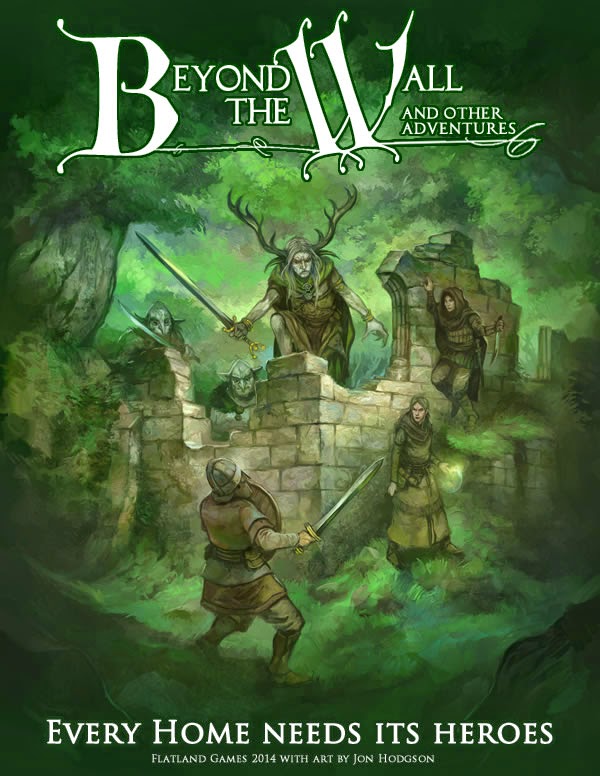
Beyond the Wall and Other Adventures: Initial Reactions


Back in February, when I blogged about the experiences that brought me to role-gaming, I mentioned my encounter with J. R. R. Tolkien's Hobbit as possibly the crucial factor in making me primarily a fan of fantasy (and thus only secondarily a fan of science-fiction). Tolkien was certainly the first author to introduce me to fantasy, but Lloyd Alexander followed right upon the Professor's heels. In fact, I'm almost certain that I picked up my copy of Alexander's The Black Cauldron (the 1980 Laurel-Leaf edition with the blue-edged pages and the Jean-Leon Huens cover illustration depicted above) at the same Book Fair where I acquired my first copies of The Fellowship of the Ring and The Two Towers. I thus came to Prydain only a few weeks after I first visited Middle-earth.

I also had the honor of speaking with Lloyd Alexander twice: first as a sixth-grader participating in a phone interview and then as a graduate student in Philadelphia attending a meet-and-greet at Chris's Corner bookstore. After the phone interview, my reading teacher Marty Podskoch gave me a publicity photo of Alexander playing the violin; said photo now hangs on my living room wall. The bookstore meet-and-greet resulted in an autographed hardcover of Black Cauldron that is probably my most carefully guarded book. So I guess you could say that Lloyd Alexander meant—and still means—a lot to me.

Which is why I'm always surprised that Alexander never had a greater effect on role-gaming. He was certainly a factor in my own early gaming: one of my first Tunnels & Trolls character was a rip-off of Gurgi, and I remember adding Gurgi's ever-full sack of food to a list of Dungeons & Dragons magic items I was writing up. But beyond my own initial games I don't recall Alexander having much of a significant influence.

Until now: Flatland Games has just published Beyond the Wall and Other Adventures, a D&D neoclone explicitly "Inspired by the works of Ursula K. Le Guin and Lloyd Alexander" (as the BTW website puts it). What distinguishes BTW from other neoclones is its focus on the party as a band of "young heroes finding their way in dangerous situations" (p. 2 of the Core Rules booklet). D&D as YA fantasy instead of sword-and-sorcery, if you will.


Although it appears that you can more or less run the game as a rules-light version of D&D, BTW's "killer app" is its use of Character Playbooks (randomized life-paths generating different versions of YA fantasy archetypes) and Out-of-the-Box Play (as the players generate their characters using the Playbooks, their dice rolls help to generate the party's home village and influence the GM's scenario—the adventure provided with the initial rules has blank spaces for GMs to insert character-specific information and hooks that shape the way the scenario plays out).

BTW's approach to fantasy thus aims right at the oracular-pig-shaped hole in my gaming heart. I'm going to take some time tonight to roll up a character using one of the Playbooks (either a Taran-esque "Village Hero" or an Eilonwy-esque "Witch's Prentice"). Since BTW assumes that the players will create their heroes as a group (the sixth table in every Playbook not only generates a stat bonus for the character in question, but for the character of the player to the right), this sample hero won't be a completely accurate test case for the game. But I think it will nicely get at just what BTW has to offer the role-gaming scene.