Friday, February 6, 2015

[Supers!] Big Hero 6's Wasabi


With the DVD/Blu-Ray release of Disney's Big Hero 6 coming up on February 24th, I thought it might be fun to stat up at least one of the members of the team. So here's the Supers! Revised Edition sheet for Wasabi, my favorite character in the film.

Wasabi

Resistances (5D)
Composure 1D
Fortitude 3D
Reaction 2D
Will 3D

Aptitudes (8D)
Academia 3D (Lasers 4D, Applied Physics 4D)
Athleticism 2D
Fighting 2D
Technology 3D

Powers (7D)
Armor 3D (Device -1D)
Super Weapon 5D (Plasma Blades, Split Action 1D, Device -1D)

Advantages (1D)
I Brought This Along 1D ("What do you need, little man? Deodorant? Breath mint? Fresh pair of underpants?")

Disadvantages (-2D)
Enemy (Yokai/Callaghan) 1D
Minor Mental Hindrance ("A place for everything, everything in its place") -1D

Competency Dice (1D)

Since the characters in Big Hero 6 are all starting their characters, I built Wasabi using the standard Supers! amount of 20 build dice. He's a big guy, and he doesn't give up, so Fortitude and Will were his top Resistances. He is also easily flustered, so Composure at 1D seems appropriate. The Athleticism and Fighting Aptitudes reflect his experience with tai chi; I've given him "lasers" and "applied physics" as specializations for his Academia, but I could just as easily move "lasers" to be a Technology specialization. Note that Wasabi very deliberately doesn't have any extra dice in Vehicles ("You have to indicate your turn, it's the law!"). Powers are straightforward: his Big Hero 6 costume ("Anyone else's suit riding up on them?") doubles as high-quality Armor, and his plasma blades are a Super Weapon with a Split Action Boost (since he can use the blades independently of one another for attack and defense). The Advantage is an obvious choice given the quote I've attached to it. Even though Yokai/Callaghan's daughter is safe, he's still in play as a potential Enemy, and Wasabi's OCD is a definite Minor Mental Hindrance. I didn't give him a Phobia (Heights) because, while he whines about having to fly holding on to Baymax, he seems just fine fighting Yokai at various elevations. Finally, I left him with a Competency Die just because it's a good idea.

Wednesday, February 4, 2015

Teaching Contemporary Fantasy in Spring 2015


Sorry about the delay in blogging here at Vargold: the end of the Fall 2014 semester, family vacation time during the winter break, and the beginning of the Spring 2015 semester have forced me to concentrate on non-blogging and (really) non-gaming matters. But I thought that I could at least spare a few moments to talk about my current course on contemporary fantasy novels. I've done the historical approach numerous times now, and I thought it might be interesting to concentrate only on recent books instead. I also decided to bite the bullet re J. K. Rowling and finally add a Harry Potter novel to my teaching repertoire. Since Harry Potter and the Prisoner of Azkaban is my favorite Potter book, this made 1999 the terminus ab quo for the class. I also decided to try and split the reading list down the middle in both national and gender terms: four Brits and four Americans, four men and four women. The national split was easy to accomplish, with Rowling, Miéville, Pratchett, and Walton representing the UK and Le Guin, Díaz, Jemisin, and Wilson representing the States. I ended up with a slightly lopsided gender split of five women (Rowling, Le Guin, Jemisin, Walton, and Wilson) and three men (Miéville, Díaz, and Pratchett), largely because most of the contemporary male fantasists I admire are British writers (e.g., Joe Abercrombie, Neil Gaiman, etc.) and I already had enough Brits. I also tried to increase the presence of writers of color in the class (Díaz and Jemisin), a move augmented by books by white authors with explicitly non-white protagonists (Le Guin's Memer and Wilson's Alif). Finally, I owed Jemisin one, having dropped One Hundred Thousand Kingdoms from my Summer 2013 fantasy class.

In the end, I think I came up with a fairly diverse set of recent fantasy novels, both in social terms as well as thematic ones. The Brief Wondrous Life of Oscar Wao is the odd book out as it's less a straightforward fantasy and more of a reflection on fantasy fiction's embeddedness in the imperialist and colonialist projects of the modern West. But then my sense is that most of the best fantasies are explicitly books about writing and fiction and the nature/power of language—so the more meta Oscar Wao fits right in in this regard.

Right now we've just started The Scar. Our class discussion of Prisoner of Azkaban was outstanding: the students did a great job, and I developed a new respect for what Rowling was doing in that novel, especially in relation to the uncanny and the problem of the past.

Monday, December 8, 2014

[Into the Odd] Hypatia Handel and Mr. Sweets (NPCs)


The Favorite © 2010 Omar Rayyan 

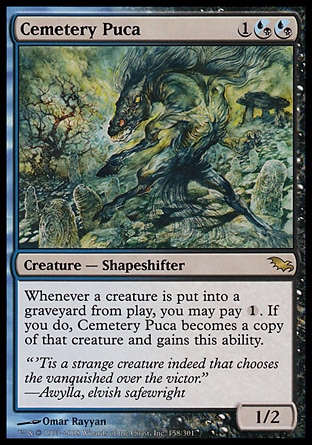
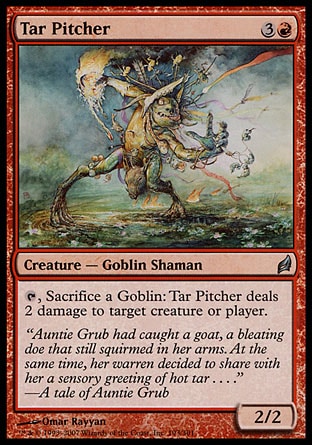
As I noted in my last post, I love Chris McDowall's Into the Odd. I also love the artwork of Omar Rayyan. (There are signed and framed prints of Rayyan's Cemetery Puca and Tar Pitcher illustrations for Magic: The Gathering on my office wall.) Finally, I love image-based character creation (as utilized in, say, the late, lamented Everway RPG).

So why not put them all together? I'm going to generate a series of Into the Odd NPCs using some of my favorite Rayyan paintings and illustrations, beginning with the lovely 2010 piece depicted above ...

Hypatia Handel
STR 7, DEX 12, WIL 17, 3 HP.

Penknife (d6), 3S.

Blond and lacy. DRIVEN TO EXPLORE THE UNDERGROUND—ALL OF IT. (After all, the rest of Mr. Sweets's family must be down there somewhere?)

Mr. Sweets
STR 17, DEX 12, WIL 10, hp 10, Armour 1.

Leathery, baggy, and ugly—but strangely redolent of lavender. DRIVEN TO PROTECT HYPATIA AT ALL COSTS. Mr. Sweets usually attacks with his claws and bite (d6), but he will gore a target with his horns (d8) if he has room to charge.

... What, you thought Mr. Sweets was using Hypatia to conquer Bastion for his foul kind? He's really just the classic "hideous yet loyal pet that only a child can love"—but in Bastion, those pets come with fangs and claws and abdomen-ripping horns. I envision Hypatia's parents hiring PCs to track her down on one of her Underground jaunts; Hypatia could also be a valuable source of information about just what's underneath the city streets.

Wednesday, December 3, 2014

[Into the Odd] Initial Thoughts


I'm currently obsessed with Chris McDowell's Into the Odd, an extremely streamlined D&D neoclone published in PDF and print formats by Paolo Greco under the Lost Pages imprint. I'm not joking about the streamlined part: an Into the Odd character first rolls 3d6 to generate Strength, Dexterity, and Willpower scores, then rolls 1d6 for HP, and finally chooses a starting package of equipment based on the intersection of his highest ability score and his HP total. That's it. It's so easy I'll do it right now ...

OK, I rolled a 16 STR, a 12 DEX, and a 5 WIL plus a 2 for HP. Clearly this character is a powerful brawler with a decent amount of speed and agility—but his will is incredibly weak. He's very impulse-driven and not at all good with the occult. His starting package of gear consists of a staff (d8 damage), a pair of tongs, and some glue. Not great equipment, but if his STR were any higher, he'd be looking at a prosthetic leg or one arm! (As your abilities and HP increase, your results on the starting gear table grow more ... ambivalent.)

Once play begins, the rules are incredibly simple. When your character chooses to do something risky or dangerous, you make a saving roll versus the relevant ability. Equal or under your score succeeds. Combat's deadly by design: there are no hit rolls, just damage rolls. Damage comes off HP first; when that total zeroes out, the character makes a STR save to avoid Critical Damage (i.e., being incapacitated and in danger of dying unless tended to within an hour). Assuming the save is made, the character then takes damage off his STR score. At 0 STR, death ensues.

Of course, simplified D&D clones like this aren't anything particularly new these days. The system in Into the Odd is mostly designed to get out of the way, letting players focus instead on the fiction, the experience of the game—and this is where Into the Odd really shines.

The game's setting can best be described as "China Miéville meets OD&D." There is Bastion, a teeming metropolis technologically situated somewhen between the late seventeenth and early nineteenth centuries. (Factories turn out firearms and the like, but swords are still commonly used.) Beyond Bastion's walls and its ring of sister cities are the largely abandoned Deep Country and the exotic Golden Lands. To the north lies the mysterious and deadly Polar Ocean. Oh, and there's trouble both above and below: beings are raining down into Bastion's streets from the Stars while monsters bubble up from the city's Underground, an endless chthonic playground.

A typical scenario involves the discovery and exploration of weird, eldritch ruins or landscapes in search of Arcana, strange artifacts capable of granting great powers as well as twisted curses. In other words, the player characters end up looking an awful lot like the adventurers who assist Isaac in Perdido Street Station or the salvors in Railsea. (Bastion-centered scenarios will feel more like the former novel while adventures in the Golden Lands will tend toward the latter book.)

It's the weird touch that attracts me to what's possibly an even more brutal ruleset than OD&D. When I'm playing a sword-and-sorcery or high fantasy game, I have trouble dealing with the low life expectancy of Old School characters. But transpose everything to a bizarre salvage-punk environment, and I'm golden.

Looking forward to getting a chance to play Into the Odd soon!


Wednesday, November 5, 2014

[Beyond the Wall] Revised Edition On the Way


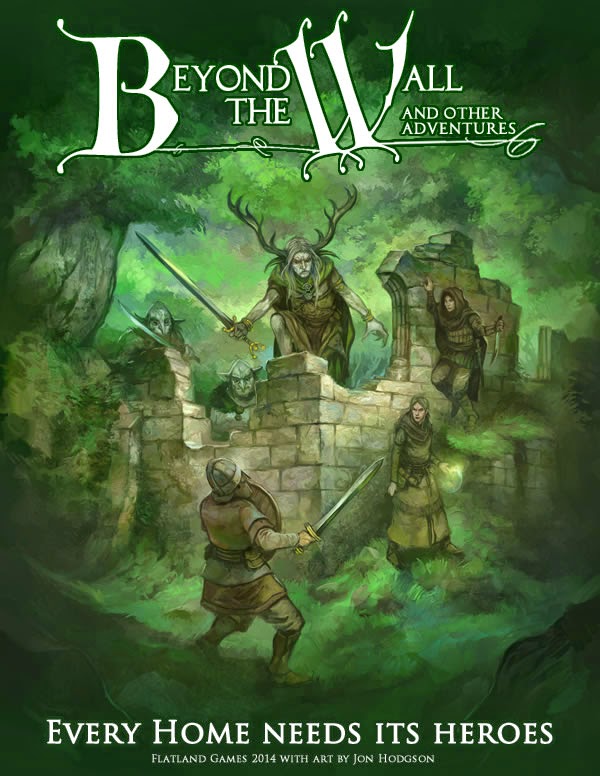
When Peter Williams of Flatland Games posted this Jon Hodgson image in the BtW thread on RPGnet, I was all


Then he went and posted this image of new Erin Lowe artwork:


And I was all


Today the bastard went and added this image to the thread:


Frickin' Larry MacDougall. Why do you torment me so, Peter? Why? Sell me the damn game already!

As my daughter said back when she was in preschool, "Patience hurts you."

(They were trying to teach her "Patience is a virtue," but my little girl knew more about patience than that.)

Monday, October 27, 2014

The D&D Player's Worst Nightmare ...


Last year I gave you a beholder pumpkin. This year I give you the one thing no player of D&D wants to meet on a dark tabletop at midnight. Happy Halloween 2014!

Friday, October 3, 2014

[Supers!] Brute Squad


Last night I started playing in a Supers! Revised campaign at my FLGS. I knew going into the game that I wanted to play a brick, but I was having trouble coming up with a concept that worked ... until a thesaurus search turned up "brute." Suddenly the light bulb went on: "brute" leads to "brute squad" leads to "brick with the ability to duplicate himself."

In other words ...


With this mental breakthrough, my character came together in a flash. Here are the stats for Brute Squad, a former henchman trying to make it as a hero:

Brute Squad

a.k.a. Andrew Irons

Resistances (7D)
Composure 2D
Fortitude 4D
Reaction 3D
Will 2D

Aptitudes (4D)
Athleticism 3D
Fighting 3D

Powers (12D)
Armor 4D
Duplicate Self 4D
Super Strength 4D

Advantages (1D)
Is That Your Best Shot?

Disadvantages (-4D)
Enemy (Wise Guy)
Obligation (Parole Officer)
Social Hindrance (Disreputable)
Social Hindrance (Ugly)

Competency Dice (2D)

Backstory
Andrew Irons grew up on the wrong side of the tracks. He didn't have many options in life, and his brutish looks didn't help him win friends and influence people. A crappy job in an unsafe factory exposed him to a bizarre chemical solution, granting him the typical brick power suite as well as the more unusual ability to duplicate himself. His newfound abilities made him particularly attractive to the villain community, and "Brute Squad" found himself working as a henchman to a number of different bad guys. But his heart was never in his villain work. In fact, when his last boss, the super-genius crime lord Wise Guy, ordered him to execute a captured superhero, Brute Squad not only refused to do the deed but turned on Wise Guy as well. After serving a shortened sentence on account of his face turn, Brute Squad tried to find legitimate work for a man of his talents. But this ex-con is having trouble finding anyone who trusts him: will he stay a hero, or will he fall back into a life of crime?

Monday, September 29, 2014

[13th Age] Goodbye, Half-Orcs; Hello, Beast Folk?


Just a little thought-experiment here, something I'm contemplating for my own version of the Dragon Empire after reading some online discussion of half-orc origins:

13th Age gets away from the problematic origins of the traditional D&D half-orc by explaining the species not as the product of sexual violence but as a High Druid-initiated immune response to the return of the Orc Lord and the concomitant rise in orc populations. Walking, talking lymphocytes, if you all.

As a way of avoiding the inscription of rape into the game setting, this certainly works. But it does raise a new question: why use a breeding-related term for the resulting species of pseudo-orcs? Obviously the answer is "because 13th Age tries to preserve the sacred cows of D&D tradition whenever possible," but that meta-explanation doesn't make much sense within the fictional context of the Empire.

What I'm thinking then (and I suspect a Google search would demonstrate that I'm in no way original here) is to recast the half-orcs as an entirely different species: beast folk. The precise appearance of the beast folk is still up for grabs: they could just look like brutish humans with excessive body hair and pronounced canines, or they could have many more animal features, features that might be tied to specific subpopulations (a wolf group, a deer group, etc.).

But the advantage of either approach is that the existing half-orc stat block (bonuses to either STR or DEX and the Lethal racial power) can apply to the beast folk concept without any changes needed. The beast folk backstory also nicely maps onto the existing half-orc one: the beast folk of the frozen north have frequently been enemies of the Empire, but with the resurgence of both the Orc Lord and the High Druid, the Emperor has seen fit to make peace with his former foes and to support them against the hordes on their borders. (Especially since the Dwarf King's attention to the orcs frequently wavers based on whatever is bubbling up beneath his delvings that week.)

Thoughts?

Friday, September 26, 2014

[13th Age] One Unique Thing, Rat Queens Style


I can't be the only person in the world who thought "One Unique Thing" when reading this panel of Hannah and Orc Dave in Kurtis Wiebe and Rob Upchurch's Rat Queens #5, can I?

[13th Age] 13 Pregens


As I recently mentioned, I'm in the process of producing thirteen pregenerated first-level characters for use with 13th Age. This series is partially intended to be a resource for other 13th Age players: the characters can be used as springboards for other characters, as NPCs for GMs in need of a contact or some such, or even as characters in their own right. But it's also meant for me to get outside of my ranger-shaped comfort zone and try my hand at some concepts I don't normally explore.

At present, 13th Age has fourteen races (aasimar, dark elves, dragonics, dwarves, forgeborn, gnomes, half-elves, halflings, half-orcs, high elves, humans, tieflings, and wood elves in the main rulebook; tywyzogs in the Bestiary) and fourteen classes (barbarians, bards, clerics, fighters, paladins, rangers, rogues, sorcerers, and wizards in the main book; chaos mages, commanders, druids, necromancers, and occultists in 13 True Ways) in print. I'm going to ignore the tywyzog and the occultist for the purposes of this experiment, giving me a nice round thirteen by thirteen grid of options.

Here are the thirteen characters in order of their creation:

1. Sergeant Kesek, 1st Level Dragonic Commander

2. Red Nose Roger, 1st Level Human Ranger

3.

4.

5.

6.

7.

8.

9.

10.

11.

12.

13.

Feedback is of course welcome, and I'd love to hear if anyone ends up making use of the characters.

Friday, September 19, 2014

[13th Age] Red Nose Roger, 1st Level Human Ranger


Something I've been toying around with in my head for the last month or so is a series of thirteen first-level 13th Age characters—partially as a means of really familiarizing myself with all of the classes and races in the game, but also as a way to provide starting pre-gen characters for the larger 13th Age community. Putting together the stats for Sergeant Kesek, the dragonic commander, convinced me that I needed to follow through on this idea, and this post is thus the second in the series.

I'm a big fan of rangers as a class, especially when they're given access to pets. (My time playing a dwarf hunter in World of Warcraft is a big factor here.) Since I've already created a fourth-level ranger with the Animal Companion talent (Mim the gnome and her woolly rhino Loth), I thought I'd opt for something smaller this time round and go with Ranger's Pet as the core of the character. At which point I realized that I could generate a rat-catcher, everyone's favorite career from Warhammer Fantasy Roleplay, and give 13th Age fans game stats for the notorious "small but vicious dog."

A vermin hunter isn't the typical ranger hunter archetype, but then again the sewers of the Dragon Empire are nowhere near as tame as our more mundane sewers—albino alligators would be the least of a sewer-dweller's problems! So the Empire needs brave (desperate) heroes (losers) to journey below and protect its cities from drainage-dwelling monsters.

Red Nose Roger, Human Ranger

Level 1

STR 12 (+1), CON 16 (+3), DEX 18 (+4), INT 10 (0), WIS 14 (+2), CHA 8 (-1)

AC 18, PD 15, MD 11

HP 30, Recoveries 8 @ 1d8+3 per recovery

One Unique Thing: After my nose was bitten off while cleansing the Horizon sewers, the Archmage gave me a orichalcum replacement. Now I smell things that aren't there.

Icon Relationships: Archmage +1, Emperor +1, Prince of Shadows +1

Backgrounds: Born a beggar on the streets of Axis +4, kitchen drudge for the Imperial Court +4, licensed as one of His Imperial Majesty's Rat-Catchers +5

Racial Power: Quick to Fight

Class Talents: Favored Enemy (defaults to beasts), Ranger's Pet, Tracker

Feats: Favored Enemy (Adventurer), Ranger's Pet (Adventurer)

Basic Melee Attack: +5 vs. AC, 1d8+1 damage, 1 miss damage (iron-bound cudgel) or +5 attack, 1d6+1 damage, 1 miss damage (excessive knife)

Basic Ranged Attack: +5 attack vs. AC, 1d6+4 damage (sling)

Gear: Leather armor, iron-bound cudgel, excessive knife, sling, 25 gp

Roger's backgrounds give him ins with the urban poor and the servants dwelling downstairs in the houses of the nobility. His efforts to stop a particularly bad infestation in one of the Emperor's palaces led to his appointment as an Imperial Rat-Catcher—a license that has taken him to the sewers of all the cities on the Midland Sea. It's this third background that was picked up with Roger's urban variant of the Tracker talent: as suggested by the folks on the 13th Age Google+ page, the text of Roger's Tracker talent reads "urban" where the book says "wilderness" and vice versa. To gain facility in tracking beyond the city walls, Roger will need to acquire the relevant feats (now inverted to cover wilderness environments). Roger's backgrounds account for his positive Icon relationship with both the Archmage and the Emperor—but a man can't spend as much time in the sewers as Roger has without developing a working relationship with the Prince of Shadows as well. Roger just never mentions this to his superiors in the Imperial Household.

Snapper, Small but Vicious Dog

Abilities: Counter-bite, Tough

Snapper was obviously destined to take the Counter-bite ability, but I also wanted him to have that irrepressible mutt quality. I therefore used Crooked Roger's second feat choice (the one he got from being human) to purchase the Adventurer feat for Ranger's Pet and cover the two ability slots needed for Tough. The result is a nasty little bastard who will nip anyone getting too close to his master.