Thursday, June 26, 2014

Kirby Page Layout ... Now with Panther Power


[Time for another Thursday "reprint" from Kracalataka, this time from 4 August 2011]

There's a Kirby page from Fantastic Four #52--the Black Panther's debut issue--that I've been wanting to talk about ever since I read Hagop's lovely discussion of it at The Short Box back in February.  Here's the page in question:


Hagop does a good job of discussing what makes individual panels on this page exemplars of Kirby's style.  What I'd like to add to that analysis is a reading of the page's overall layout, one that takes into account Kirby's ability to masterfully direct the reader's eye from one panel to the next.

For example, we once again see our old friend the Z-pattern.  Here it's based on Ben Grimm (with an assist from Johnny Storm).  In panel 1, Ben rushes toward the right edge of the panel (and the page), attempting to seize the FF's Wakandan guide before he escapes.  The motion lines contribute to the rightward dynamic of the panel.  In panel 2, Ben's figure still anchors the Z-pattern, but now Ben has been flipped right-to-left, and his left arm points down and left, directing our eyes to the second tier of panels.  Panel 3 (the first panel of the second tier) continues the downward diagonal begun in panel 2.  Finally, the Z-pattern is completed on the third tier of panels in panel 5: the falling figure of the Thing completes the downward diagonal's leftward motion, and the Torch's sprawling form pulls us to the right edge of the page, finishing the base of the Z.  (This is why it's important that the Torch show up in panel 3, supporting Ben from the right side of that panel--the same basic layout of figures that we see in panel 5.)

Kirby complicates matters with the appearance of T'Challa in panel 4.  Visuals match the narrative here as T'Challa intrudes upon the Fantastic Four, and the figure of the Black Panther breaks into the Z-pattern of the page.  Where the Panther is concerned, panels 4 and 5 form a second downward diagonal parallel to the first.  T'Challa leaps down upon the unsuspecting heroes in panel 4, a jump completed in panel 5 as he knocks them sprawling.  (The legs akimbo of panel 4 become the complete spread of panel 5--a single fluid motion captured in two moments.)

The Panther's attack also disrupts the page's panel grid.  Up until panel 5, we've been led to expect a six-panel grid broken down into two panels per tier, three tiers page (exactly what we'll get on the next page of the issue, page 11, and throughout much of the issue as a whole).  Kirby departs from that expectation here, giving us  instead a single elongated panel that covers the full extent of the tier.  Story drives layout: T'Challa kicks Ben and Johnny, and their flying bodies literally push the panel down and out toward the edges of the page--to the point where Johnny's body pressures the boundaries of human physiology to mimic the right angle of the panel's lower righthand corner. Again, motion lines are used expertly here, extending the panel out from the center point of T'Challa--whose impossibly split legs also copy the panel boundary (in this case, the long horizontal line at the top).  The Black Panther pushes the bottom line of the Z to its limits, causing it to bow out in the middle.

It's the clarity of layout that impresses me the most here.  While I love much of the art in modern comics, I find that the layout skills pioneered by Kirby and others are less in evidence, an absence of craft that undermines the reading experience.  But there are some nice modern counter-examples, and I'll discuss a few of those when I next find a chance to look at page layout.

Monday, June 23, 2014

Actual Play: Free RPG Day, 2014 Edition


I took part in this year's Free RPG Day celebration at Armored Gopher Games, my FLGS, and the event was an overwhelming success: five games, all of which ran with full tables, and a quickly depleted stack of free RPG materials. Since I was both a player and a referee this year, I thought I'd throw together an actual play post describing what went on.

(L to R) Ka-Boom, Primal, Lawman, Freeze-Tag, and Co-Opt

My stint at referee came first: starting at 11 a.m., I ran a session devoted to Hazard Studio's Supers! Revised game. I had a six-hour time slot, so I opted to let the players create their own heroes instead of using pre-gens. Since Supers! Revised is not yet in print (due to hijinks beyond Hazard's control), I had to rely on the single PDF copy on my MacBook hard drive. This created something of an information bottle-neck, although I was able to make copies of the extremely helpful Character Creation Guide provided in the back of the rulebook. It didn't hurt that the nature of Supers! Revised as a game doesn't necessitate frequent look-ups to build a character: not only does the Guide list all Resistances, Aptitudes, Powers, Boosts, Complications, Advantages, and Disadvantages but the game's relative simplicity means that dice devoted to a given Power are a more or less transparent indicator of the character's ability with that Power. (There was some fiddling with the rulebook to ensure that characters' Power dice matched up with their hero concepts, but nothing like I experienced the one time I tried to referee a Champions character creation session.)

My five players came up with the following supers:

The Lawman - Western sheriff descended from a long line of law enforcers. Carries his ancestor's six-shooter (a weapon that fires ghost bullets) and badge (affording him mystic protection from harm).

Freeze-Tag - Bounty-hunter with the ability to teleport to his quarries and stop them in their tracks with a paralytic touch. (The name was my suggestion to the player, but the powers pairing was his—and so wonderful that I will be stealing the character for use as a campaign NPC.)

Co-Opt - A hero whose powers are all about taking from others (co-opting their metahuman abilities with Power Steal and their skills with Mimic Aptitude) and then sharing them with himself (by cooperating with his duplicates). He also had Super Speed but rolled poorly with it all session, causing the other players to dub him "Worst Speedster EVER."

Ka-Boom - A skilled fighter whose primary power was her BFG. It went "KA-BOOM" when fired (natch).

Primal - A robot able to morph into any size animal form contained in its data banks.


I then tested the heroes' capabilities by running them through a fairly straightforward scenario, Hazard's Scene Stealers: Black Ice. The team found itself in hot pursuit of Cold Kill, a notorious super-villain who was in the midst of hijacking an armored truck. The chase was more or less a cinch for the players: Freeze-Tag kept teleporting from block to block to keep up with the truck, Co-Opt relied on his super-speed, Primal turned into a silver-maned stallion and carried Lawman on its back, and Ka-Boom ... well, I let her pick from the list of commandeered pursuit vehicles contained in the scenario, and she chose the ice-cream truck.

Cold Kill was definitely outnumbered, although he did nearly managed to put down Lawman and Primal with his wide-angle ice blast. (The ice-cream truck was totaled by the same blast. You served Ka-Boom well, Mr. Softee!) The team then more or less beat him down with a minimum of fuss. Unfortunately for them, the arrest was complicated by the on-site crash of a private plane ... and the arrival of Rio de Sangue, a contract killer who wanted the briefcase possessed by one of the passengers.

(Rio's nom-de-guerre led to much mocking by the heroes: "His name is Rio, and he dances on your glands ... Oh, Rio, Rio, you have got a severed hand!")

As a 35D villain, Rio was much more of a challenge for the team. His numerous super-abilities (including his hellacious 5D Armor) made it difficult for them to get in a decisive blow. On the other hand, Rio was equally outnumbered. Once Primal realized the armor's weakness (it didn't protect Rio's head, something Primal discovered when it shifted into condor form and tried to scratch out the villain's eyes), he got the rest of the team to start taking called shots. Rio attempted to escape by flying away, but Primal shifted into pterodactyl form and took him down. Cue end credits!

Everyone had a great time playing Supers! Revised; the only real complaint came from a few players who realized mid-scenario that they should have built their heroes differently to get the effects they wanted (and even these players agreed that they were talking more about fine-tuning than a completely misleading ruleset). My one regret as a referee was the massive beating my solo villains took as a result of serious outnumbering; I probably should have given Rio some minions as back-up to occupy some of the heroes and minimize the ganging-up effect. But then I didn't anticipate five players! (There was much less attendance for at the Gopher's 2013 Free RPG Day event.)


After a break for dinner with my family, I came back to the store for the second session of the event. This time I was a player in my friend Dave's Dungeon World event. Dave was running a scenario based on Mike Carr's Dungeon Module B1: In Search of the Unknown. He had tried to run the adventure the previous year but had insufficient players show up (i.e., just me). He had even tried to run it at home for me and another friend, but a TPK in the first encounter and a lack of time to start over had deep-sized that attempt. Hope springs eternal, though, and Dave offered the scenario again at this year's event. As mentioned above, he made the right call, ending up (like all the other games this year) with a full table.

I'll let Dave have the honor over at his blog of describing what transpired at the table. But I will note that I had a blast playing my swashbuckling Elf Fighter (who wore a fake mustache in the finest Fairbanks-Flynn tradition). Perhaps my crowning glory was the moment when I checked for traps by the corpse of a dead halfling thief onto a pile of treasure. There wasn't any trap, but I did manage to wake up the chimera who owned said treasure ...

Thanks to the Gopher staff for hosting Free RPG Day, to my players for showing up and indulging my desire to run Supers! Revised, and to Dave for sticking it out and finally getting to run his Dungeon World adventure!

Thursday, June 19, 2014

More Kirby Layout Goodness


[Another "reprint" from my defunct Kracalactaka! blog. Edited to remove a reference to a 2010 familial health crisis that ended for the better.]

This time let's look at a page from Fantastic Four #58 . . .


What we've got here is a beautiful Z-pattern that naturally syncs your eyes and the flow of narrative action on the page. The eye goes from Ben to Ben in each panel (expect for the transition between panels 5 and 6 which is handled via Doom's figure as well as the natural causal link between the makeshift spear in Ben's hand and the explosion that spear causes when it hits Doom). There is also the same sort of X-pattern that I discussed in my previous post on Kirby's Thor layouts. You have a line descending from the "ZAFFT!" in panel 1 through the "RAKK!" in panel 3 to the "ZOT!" in panel 5. Crossing that line is the one descending from the Ben Grimm in panel 2 through the Ben in panel 3 to the Ben in panel 4. The diagonal line formed by the wreckage that Ben demolishes in panel 3 adds to this larger portion of the X-pattern.

There's also a lovely bit of variation in panel size and shape here as well. The top and bottom tiers of panels consist of two equally-sized squares each. These tiers serve to frame the middle panel, a single rectangle that expands left (with the eye's own motion as it shifts down and left from panel 2) to mirror Ben's violent action in panel. A nice bit of emphasis by the King here!

Friday, June 13, 2014

Why So Many Good Superhero RPGs Now?


Over at RPGnet, someone has posted a poll asking folks which system (Capes, Cowls, and Villains Foul or Supers! Revised) they'd use to run a Justice League campaign. While the poll is running in favor of my preferred superhero ruleset (Supers! Revised), the discussion has made it clear that either game would be a perfectly fine choice. Meanwhile, Steve Kenson is getting ready to release a revised edition of Icons, his acclaimed superhero RPG, HERO Games has a streamlined edition of Champions available, Paragons & Prowlers is getting decent buzz, etc., etc.

What's going on? Why are we living in a veritable Golden Age of superhero games? (Roleplaying games are generally in a good place right now design-wise, but superhero games seem to be doing especially well—I don't really see any sort of edition-warring taking place between systems.) Theories?

Thursday, June 12, 2014

Why Kirby Is King


[This post was originally published on my now-defunct Kracalataka! blog back on 7 July 2010. I'm going to be slowly moving the more interesting posts from that blog here to Vargold over the next few weeks.]

I've been reading the Stan Lee/Jack Kirby run on The Mighty Thor, and I came across these pages from Thor 137 ("The Thunder God and the Troll") that demonstrate Kirby's command of page layout.  Here's page 2, my first example:


Here Kirby depicts a competition between Thor and the goddess Sif, his new love interest.  (I get the sense that, by issue 137, even Lee was getting tired of mortal love interest Jane Foster.)  What I love about the layout on this page is the interaction of the six panels.  The first panel (Sif launching a javelin toward the reader's right) is mirrored by the sixth and last panel (Thor throwing Mjolnir toward the reader's left).  The second panel (Sif's javelin lodging in the pole) is mirrored by the fifth and penultimate panel (where the force of Mjolnir's impact on the ground causes the spears to burst out of the pole).  The overall effect is that of an "X" pattern: panels 1 and 6 form the first line of the X while panels 2 and 5 form the second line.  The coloring ties the layout together even more.  (There's no colorist credited for the issue, so I'm not sure who to praise here.)  Panels 2 and 6 match up due to their yellow backgrounds—but they're also linked diagonally to panel 3 by virtue of the rather large swatch of yellow represented by Thor's golden locks.  Blue dominates the reverse pattern of panels 1, 4, and 5.

My second example is page 5:


Yellow backdrops and action lines tie together panels 1 and 4.  So does content: in both panels, Thor is smashing an enemy's weapon.  The result is a diagonal pairing that continues the force of Thor's panel 1 blow down into panel 4: in both cases, Mjolnir moves down and to the reader's right.  Panels 2 and 3 are tied together by the diagonal line linking the troll missile before and after it is launched at Thor.  In panel 2, the missile points down and left to the center of the layout; in panel 3, it zooms up and right.  The layout is once again an "X" shape.  At the same time, though, Kirby ties together panels 3 and 4 in a lovely action sequence: in panel 3, Thor prepares to strike by moving Mjolnir down and to his left.  Then, in panel 4, Thor ends the page with a "Thbooom!" by swinging his hammer across his body to his right.  The layout result is a beautiful arc of motion across the gutter between the panels.

Tuesday, June 10, 2014

[Supers!] Kitty Pryde


Supers!, Simon Washbourne's wonderful superhero RPG from 2010, has just come out in a revised edition ($10 in PDF, POD coming soon) from Hazard Studio. I haven't put together an itemized list of the differences between the two editions, but my initial pass through the revised version convinces me that Hazard has done an excellent job of clarifying the rules without unnecessarily complicating them—a very welcome outcome in the case of this, my favorite superhero game.

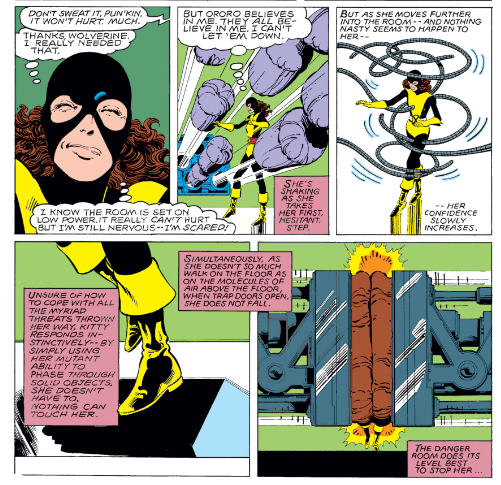
Of course, it wouldn't be a superhero RPG without a character conversion or two to see how well the rules handle archetypal comics characters. So I decided to do a Supers! RED version of my favorite Marvel mutant, phasing wunderkind Kitty Pryde. Like Josh Whedon, I too was introduced to the X-Men through Kitty's eyes, and she's remained one of my favorite characters since then.

The version I've chosen to stat up is the Kitty we see at the end of Uncanny X-Men #143 (March 1981), the final issue of John Byrne's run on the title as penciller. In this story, Kitty has to survive the attack of an N'Garai without any help from her teammates. It's a classic done-in-one, a real rite-of-passage for Kitty that more or less marks her emergence as a superhero in her own right. So it's also a perfect point to stat her up as a beginning 20D Supers! character.

Resistances (4D)
Composure 2D
Fortitude 2D
Reaction 2D
Will 2D

Kitty is not yet 14 years old, so giving her Resistances higher than 2D (already a step beyond human average) seems wrong to me.

Aptitudes (8D)
Academia 3D
Aircraft 2D
Athleticism 2D
Fighting 2D
Performance 2D
Technology 3D

Kitty is explicitly described in the comics as a genius, so I've given her MA/MS equivalent ability in academics and technology. Her 2D in Performance reflects her skill as a dancer (and looks ahead to her ability as a storyteller), while her other 2D Aptitudes are part of her X-Men training (issue #143 explicitly makes a story beat out of her SR-71 Blackbird study).

Powers (7D)
Flight 1D (only when insubstantial)
Insubstantiality 5D
Super Weaponry 4D (touch attack, only versus electronics)

Phasing is Kitty's main mutant power, so it gets the most dice. Her ability to walk on air molecules (and thus "fly" at running speed) is handled as Flight—which she gets for free courtesy of her "Only when" Complication. I've also given her Super Weaponry to reflect her power's effect on electronic systems: it's not called out as part of her power set by issue #143, but we've seen her use it to free Wolverine form a cage during the Dark Phoenix storyline.

Disadvantages (-1D)
Secret: Mutant

Kitty doesn't look like a mutant, so she doesn't get the Social Hindrance that many other mutants (e.g., Nightcrawler, Toad, etc.) get. Instead, her mutant status is a lurking secret, and its exposure becomes a plot point in future story lines.

Competency Dice (2D)

 I left Kitty with two Competency Dice to reflect her protagonist power—and also as a way of saving up for the dice she'll be spending to make Lockheed the space dragon her Companion. Well, that and the ninja training. Chris Claremont was a rather generous GM when it came to character advancement!

Tuesday, March 18, 2014

Gossamer & Shadow: Curses, Foiled Again!


Narasen, Queen of Merh (image by Daphne Danielson)

As my last post indicated, I've been reading Lords of Gossamer & Shadow, Jason Durrell's wonderful diceless RPG. The game's publishers have been released a series of mini-supplements in PDF form, and my favorite of the bunch so far has been Addendum: Blessings & Curses, a new set of powers for LoG&S characters. The essence of the Blessings / Curses power is straightforward: you pay fifteen character points for the basic ability to bless and curse, and then you add on twenty character points for a blessing / cursing pool. The twenty points in this pool can be used to construct personalized blessings and curses; all blessings and curses consist of five aspects (severity, influence, persistence, dismissal, and duration), and the various degrees of these aspects cost different numbers of points. As a blessing or curse is cast, the points used to pay for it are subtracted from the pool and remain inaccessible until the blessing or curse expires or is broken. The result is that a beginning magician will only be able to maintain a small number of minor blessings / curses or a single medium-sized one; with experience (and more character points), more mojo is available to build one's bene- and maledictions.

It's a fairly elegant little system, and I immediately begin using it to reconstruct the blessings and curses in the books I'm teaching this semester as part of my "Literature of Fantasy" course. My first attempt was this blessing from Ursula K. Le Guin's Wizard of Earthsea:
[Ged] set a charm on that salty unreliable spring. The water rose up through the sand as sweet and clear as any mountain spring in the heights of Gont, nor did it ever fail.
I rated the blessing's severity at "mild" (1 pt.)—it's just a desalination charm. Because only a single small island spring is affected, the blessing's influence would be "specific" (also 1 pt.). So far, so cheap. Things get more expensive with the blessing's persistence, though: a spring is a constant thing, so I had to take "ongoing" persistence for 4 pts. I had some options for dismissal depending on how difficult I envisioned it being to break Ged's spell; in the end, I opted for "requires effort to dismiss" (2 pts.). Even as a young mage, Ged is extraordinarily powerful, so only another full-fledged Roke graduate could cancel the blessing. Finally, I had to consider the blessing's duration. This aspect is a multiplier, not an additive, making things get expensive fairly quickly. "Nor did it ever fail" didn't leave me a lot of wiggle-room: I was going to have to choose between "lifelong" (x3 pts., a duration of decades), "generational" (x4 pts., one of centuries), or "eternal" (x5 pts., what it says on the box). Here I split the difference and took "generational."

The final cost of Ged's blessing was 32 points ([1 + 1 + 4 + 2] x 4), a spell beyond the ability of a starting character in LoG&S. Of course, Le Guin's Earthsea works along different axioms than the game: for example, blessings and curses in the novel are more or less fire-and-forget (no maintenance cost). So there's not going to be an easy match-up between the fiction and the rules.

Something similar happened with the curse I decided to replicate. By this point in the class, we had moved from Le Guin to Tanith Lee. Our course text was Night's Master, but I had enjoyed reading that book so much that I went ahead and started its sequel, Death's Master, for pure pleasure. At the start of that novel, Narasen, Queen of Merh (depicted above), has been cursed by the dying sorcerer Issak. (He attempted to assault her, and she put a spear through him.) The curse is too long to quote here, but its essence is this: the land of Merh will become infertile and barren until the man-loathing queen conceives a child—but her womb is destined never to "quicken from the seed of any man living."

I don't think it's much of a spoiler for a book called Death's Master to note that the seed of a dead man offers Narasen a way to get around Isaak's curse. But that loophole is the only way out; none of Narasen's sorcerers can break the spell. So the curse's dismissal aspect is the most expensive: "difficult to dismiss" at 4 pts. Its influence and persistence are also at maximum: the entire kingdom of Merh ("widespread, 4 pts.) is affected, and the infertility is "ongoing" (4 pts.). Severity is surprisingly less extreme: the people, animals, and plants of Merh can exist as always, but they'll never reproduce until the curse is broken. Call it "middling" (2 pts.). Duration seems straightforward: Isaak mentions that "Famine and plague shall sit dicing in the streets for mortal lives." Add to this the curse's targeting of Narasen, and I think we can stick with "lifelong" for a multiplier of x3 pts.

Once again we have a particularly expensive casting: 42 pts ([4 + 4 + 4 + 2] x 3). But Isaak is a particularly potent wizard, and, since he is dying, he's not particularly afraid to incur any Bad Stuff he needs to cover the cost of the curse. (As a GM in a diceless game where player death is negotiated, I'd be willing to let a PC get away with a death curse like this in exchange for the end of the character.) Sorry, Narasen—looks like you're going to have to go ahead and get the plot of Death's Master moving!

As mentioned above, fiction != game. So I'm not using these sample blessings and curses as a way of judging the rules for their failure to recreate the conditions of settings other than the one Jason Durrall created for LoG&S. Instead, I've been using them as a way to test the versatility of the cost scheme, and here the supplement excels. The system was able to account for all the aspects of the castings, a fact that bodes well for players who will be more inclined to act in accordance with the parameters of the LoG&S universe. So call this a strong recommendation for Addendum: Blessings & Curses, especially since the supplement will only set you back $2.99!


Monday, March 10, 2014

Gossamer & Shadow


Pick a Door, any Door (art by the amazing Jason Rainville)

Whew. Seven weeks into the semester, and I finally find some time to post here. My fantasy literature students just took their midterm (covering Dunsany, Tolkien, Vance, and Le Guin), and my global performance in the Middle Ages class has just started Yuan zaju after finishing medieval English drama. Had to give up running Tales of the 13th Age because I'm taking part in my daughter's dance recital: I'm playing the non-dancing part of the evil Spanish Governor in Pacquita, and rehearsals for the actors are on the one night all my 13th Age players could make it. Luckily, one of those players has assumed GM duties and is now running the game on Thursday nights; I'm playing a dragonspawn paladin named Sule whose One Unique Thing is a congenital allergy to god.

But the primary reason for this update is to discuss my latest RPG purchase, Rite Publishing's Lords of Gossamer & Shadow (LoG&S). I've been eyeing this system for some time, partially because it comes highly recommended by such respected folks as Rob Donoghue and Bruce Baugh and partially because its original setting removes the primary obstacle to my enjoyment of the late Erick Wujcik's Amber DRPGRoger Zelazny's Chronicles of Amber setting. (Don't get me wrong—I have nothing against Zelazny's books; I just read them far too early in my adolescence to really appreciate them.) When DriveThruRPG's GM's Day Sale dropped the price of the PDF/softcover combo to $30, I decided to take the plunge.

Still making my way through the rulebook, but I like the overall cut of the game's jib. Mechnically, I appreciate the clarity of the rules and the utility of the worksheets for player-generated Artifacts, Companions, and Domains. As an old Everway hand, the diceless side of LoG&S doesn't bother me at all: between attribute ranks, Stuff, and player tactics, I have more than enough information to adjudicate conflicts. I still can't get my head around how to integrate PCs and NPCs on the Attribute Ladder (do I need to create all the NPCs at the start of the game? if not, how do new NPCs get worked into the ladder?). I'm also thinking that there's a bit of an Amber DRPG remnant in the strange advice on p. 15 that players not be able to establish their characters' parentage—that makes sense in the familial hothouse that is Amber, but not in the more wide-open environment of the Great Stair. So far these are my biggest problems with the game.

In fact, I liked LoG&S enough to go ahead and grab all of the game's mini-supplements while the sale was still ongoing. The Addendum: Blessings & Curses powers add-on is a particular favorite of mine; look for a follow-up post test-driving those rules. 

Monday, January 20, 2014

More You "Noh" You're a Gamer ...


Kusabira by Ise Monsui (1859-1932)

... when you're trying to decide whether or not to teach a kyogen about a yamabushi priest comically overwhelmed by demonic mushroom spirits, and all you can think is "Someone fumbled their 'Turn Undead' roll!"

Sunday, January 19, 2014

You "Noh" You're a Gamer ...


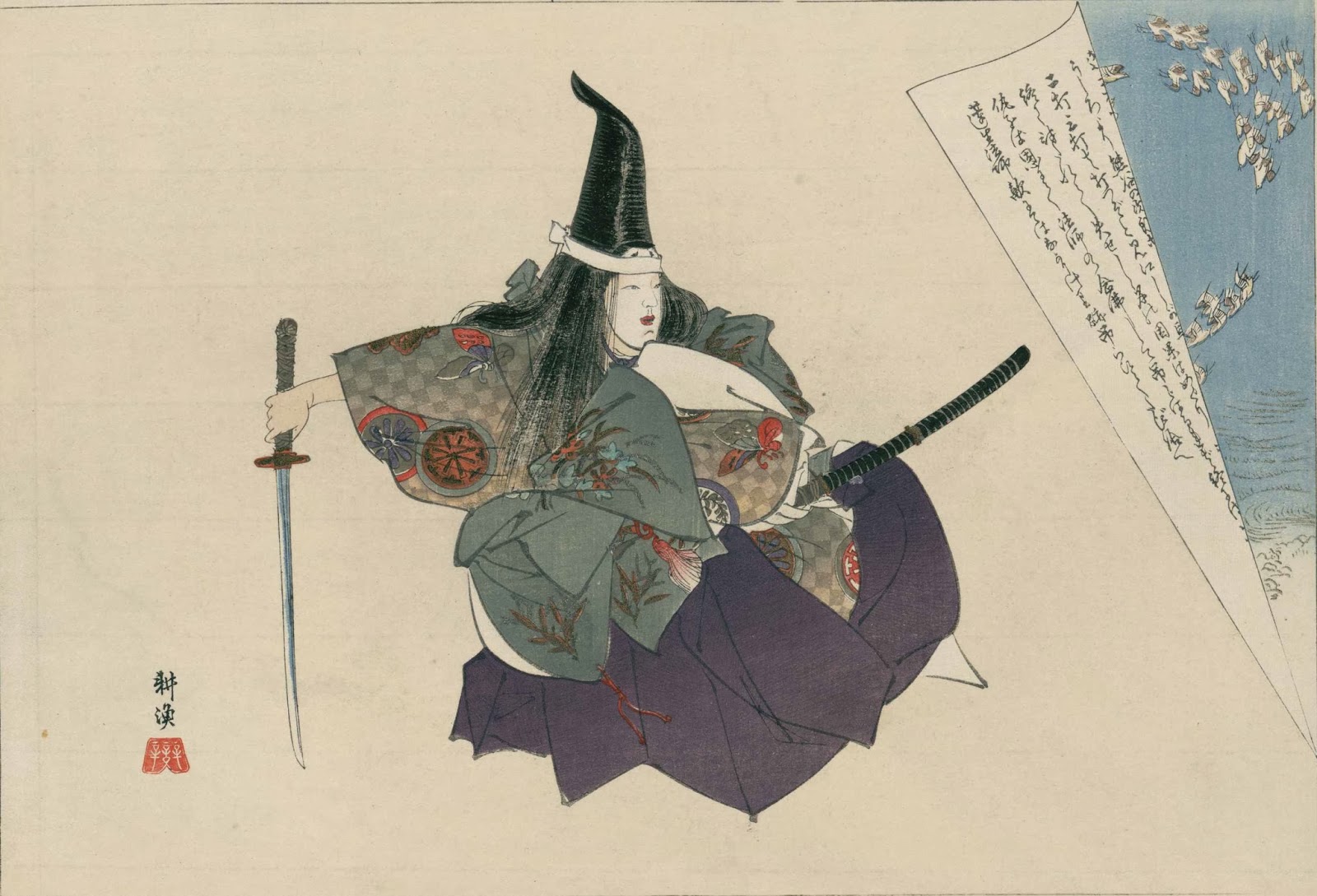
Atsumori by Tsukyioka Kogyo (1869-1927)

... when you're deciding which Muromachi-era noh plays to place on the syllabus for your spring semester "Global Performance in the Late Middle Ages" and suddenly get a hankering to buy FGU's Bushido.

Tuesday, December 31, 2013

Mae Govannen, 2014!


So, long time, no post. November 2013 was the month where my teaching and grading responsibilities combined with my familial duties to eat up my life. December 2013 was the month where Ms. Vargold suffered a pulmonary embolism and nearly left me a widower with two children under ten. (Luckily her heart was strong, and the doctors were sharp—she's back home on the mend.)

Up until now, I haven't really had the time or will to post as a result.

But I did want to check in one last time before the clock ticks over into 2014. The past year has been the blog's most productive year: 40 total posts (including this one), 12 more than the 28 posts I made in 2010. Moreover, until November went all pear-shaped, I managed to post at least once a month for ten months. Here's hoping that I can get back on that schedule in 2014!

2013 was also the year where 13th Age got me back in the GM's seat. Thanks to Pelgrane Press's organized play program, I've run (I believe) 5 sessions' worth of the game and plan on running more in the new year: the system is a blast to play!

Best wishes to everyone for a safe conclusion to 2013 and a pleasant beginning to 2014!