Monday, January 20, 2014

More You "Noh" You're a Gamer ...


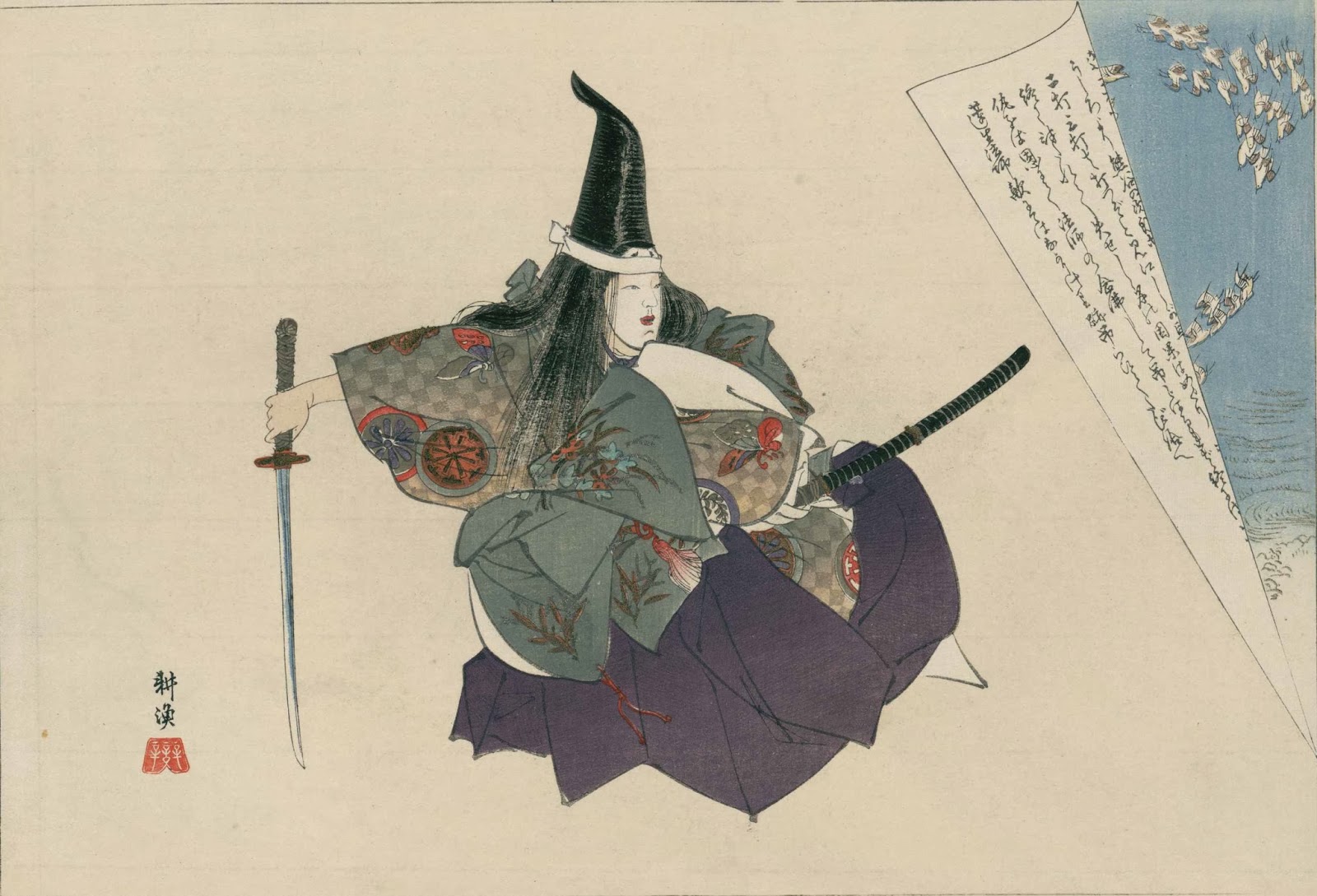
Kusabira by Ise Monsui (1859-1932)

... when you're trying to decide whether or not to teach a kyogen about a yamabushi priest comically overwhelmed by demonic mushroom spirits, and all you can think is "Someone fumbled their 'Turn Undead' roll!"

Sunday, January 19, 2014

You "Noh" You're a Gamer ...


Atsumori by Tsukyioka Kogyo (1869-1927)

... when you're deciding which Muromachi-era noh plays to place on the syllabus for your spring semester "Global Performance in the Late Middle Ages" and suddenly get a hankering to buy FGU's Bushido.

Tuesday, December 31, 2013

Mae Govannen, 2014!


So, long time, no post. November 2013 was the month where my teaching and grading responsibilities combined with my familial duties to eat up my life. December 2013 was the month where Ms. Vargold suffered a pulmonary embolism and nearly left me a widower with two children under ten. (Luckily her heart was strong, and the doctors were sharp—she's back home on the mend.)

Up until now, I haven't really had the time or will to post as a result.

But I did want to check in one last time before the clock ticks over into 2014. The past year has been the blog's most productive year: 40 total posts (including this one), 12 more than the 28 posts I made in 2010. Moreover, until November went all pear-shaped, I managed to post at least once a month for ten months. Here's hoping that I can get back on that schedule in 2014!

2013 was also the year where 13th Age got me back in the GM's seat. Thanks to Pelgrane Press's organized play program, I've run (I believe) 5 sessions' worth of the game and plan on running more in the new year: the system is a blast to play!

Best wishes to everyone for a safe conclusion to 2013 and a pleasant beginning to 2014!


Wednesday, October 30, 2013

The Best-Laid Syllabi o' Mice and Men Gang Aft Agley . . .


In my last post, I outlined my planned reading list for my Spring 2014 fantasy literature course here at Big Midwestern Flagship Public University. I was very excited about this reading list.

And then I had to submit my book order. And discovered that Patricia A. McKillip's Forgotten Beasts of Eld has gone "out of stock indefinitely"—effectively out of print. And learned that ordering the UK paperback of Poul Anderson's Broken Sword—the only in-print edition of that novel—was going to be more difficult than I had assumed. And realized that ten novels was going to be too much for the number of classes I had available for the spring semester.

Oy.

I had to make up a new reading list on the spot. The key requirement for inclusion on this list: ready availability. The secondary requirement was that each text speak explicitly to one other text on the reading list. Here are the pairings I came up with:

Dunsany's King of Elfland's Daughter (1924) and McKillip's Winter Rose (1996)


The connection here is love that reaches beyond the fields we know into Elfland: a mortal man and an elf woman in Dunsany's case, a mortal woman and an elf man in McKillip's. I'm sad to lose Forgotten Beasts, but Winter Rose is  beautiful book as well.

Tolkien's The Hobbit (1937) and McKinley's The Hero and the Crown (1984)


Two books from the last version of the reading list that make it into the next. Here the connection is dragon-slaying—a fairly tenuous theme, but a valid one. The evil of the wyrms Smaug and Maur lives on long after their deaths; in a sense, the dragons are just misdirection for the real evil of the tales.

Vance's Dying Earth (1950) and Lee's Night's Master (1978)


Decadence and exoticism drive this pair of books entering the reading list for the first time. I recently reread The Dying Earth for the first time since I was a teenager and came away incredibly impressed with what Vance achieved in those six stories; 12 or 13 was clearly too young for me to really grok them. As for Night's Master, I lost my copy of the Sci-Fi Book Club Tales of the Flat Earth omnibus back in the spring when the basement flooded. So this is my chance to finally read all of Night's Master.

Le Guin's Wizard of Earthsea (1968) and Miéville's Railsea (2012)


This pairing is so obvious I can't believe I missed it: thanks to Ceridwen Anne for the idea. Two young adult novels, two sailing stories, two great beasts (the Dragon of Pendor and Mocker Jack), and two tyro protagonists. I love Miéville's Scar, but I have included it on the reading list every time I've taught the fantasy course here—it may be suffering from overuse. So a change is good.

(Coincidentally, I'm interested in hearing suggestions for a book to pair with Le Guin's Voices—my favorite fantasy of hers—the next time I teach the course. I couldn't think of a candidate this time round.)

Pratchett's Wee Free Men (2003)


I needed a ninth book, so I decided to indulge myself and go with my favorite Pratchett of all time. What better rationale is there for a book besides Feegles? Crivens, I can't think of one!


Saturday, October 5, 2013

Reading List for My Spring 2014 "Literature of Fantasy" Course


I'm scheduled to teach my university's "Literature of Fantasy" course in the Spring 2014 semester, and, while I have yet to write a description of the class, I do have a reading list drawn up for it. Some of the texts on this list will be familiar to those of you who've read my post on the reading list for my Summer 2013 "Intro to Fiction" fantasy class: J. R. R. Tolkien's The Hobbit is back for a second round, and so are Patricia A. McKillip's Forgotten Beasts of Eld and China Miéville's Scar.

Other texts are different offerings from authors I taught this past summer:

Lord Dunsany, The King of Elfland's Daughter


Because the Spring 2014 fantasy course is scheduled to take place over fifteen weeks or so (instead of the eight weeks I had for the Summer 2013 course), I have the luxury of concentrating exclusively on longer works. In Dunsany's case, that means teaching his masterpiece. King of Elfland's Daughter is the quintessential journey "beyond the fields we know," and I enjoy teaching it as a time travel novel (even if the students aren't that interested in Dunsany's temporal musings).

Ursula K. Le Guin, A Wizard of Earthsea


I really enjoyed teaching Le Guin's Voices this summer, but I needed to teach one of Le Guin's 1960s or 1970s fantasies to make my roughly decade-by-decade survey of fantasy work for the new course. So I "reluctantly" replaced Memer's story with Ged's. I thought about pairing Wizard with Tombs of Atuan (something I've done before), but my decision to teach a total of ten novels in the spring means that I had to streamline when possible. 

Finally, because I am a masochist, I decided that I just had to teach five authors for the very first time. (This is a bad habit of mine: I prioritize teaching over research . . . which just isn't done at an R-1 school!) Here are those new authors in chronological order:

Mervyn Peake, Titus Groan


There's a very simple albeit very embarrassing reason for putting the first book of Peake's Gormenghast trilogy on the reading list for Spring 2014: I've never been able to finish any of the books in that series. I made a good faith effort earlier this year to get through Titus Groan, but stalled out around Titus's christening. So teaching Peake becomes a way to force myself to actually read his books. (Plus it will help the students understand where Miéville is coming from!)

Poul Anderson, The Broken Sword


The other, much-neglected fantasy masterpiece from 1954. (The first was Tolkien's Fellowship of the Ring.) Anderson's novel was a major influence on Michael Moorcock: for example, Stormbringer owes much to Anderson's titular blade. Of course, influencing Moorcock means influencing Miéville: there's a direct line from Uther Doul and Mightblade through Elric and Stormbringer to Skafloc and his sword. In fact, it's clear that Anderson's novel has had a much greater effect on British fantasists than his fellow Americans. I'm going to have to order the British edition of the book; there's no American edition in print for decades now.

Robin McKinley, The Hero and the Crown


Unlike Peake's Titus Groan, Robin McKinley's Hero and the Crown is a book I've read. But I'd like to become more familiar with it, so on the reading list it goes. More substantively, the novel stands in for the incredibly popular YA female fantasy hero tradition that emerges in the 1970s with characters like Anne McCaffrey's Menolly and leads to characters like Tamora Pierce's Alanna and Kristin Cashore's Katsa. I see the book playing well with Wizard of Earthsea.

Diana Wynne Jones, Dark Lord of Derkholm


I wanted some British satirical fantasy on the list, and I wanted to maintain the reading list's gender balance (five male authors, five female authors), so I turned to this wonderful book by Diana Wynne Jones. It's a hilarious piss-take on the portal quest fantasy C. S. Lewis perfected: the benighted inhabitants of a fantastic reality find themselves forced to more or less play "Tolkien" for tourists from our world.

N. K. Jemisin, The Hundred Thousand Kingdoms


I'll end the course with this outstanding 2010 debut novel from N. K. Jemisin. It's about a society that has enslaved its gods, and the plan those gods have for turning the tables—provided the heroine is willing to go along with them. The book is also representative of an ongoing reaction to the Northern European focus of most modern fantasy fiction; Jemisin, like Charles Saunders and others, is trying to reimagine fantasy for a multi-racial, multi-cultural society.

Sunday, September 29, 2013

13th Age: Wyrd of the Wild Wood, Chapters 2-3


The last thing henchman Drogan saw before he was ripped in two.

I ran a group through the second and third chapters of "Wyrd of the Wild Wood" tonight. Attendance was low again: Sundays really do just bring out the board gamers. But we decided to persevere and go ahead with just two PCs. I augmented the group's numbers with a suggestion from the Google+ 13th Age community, giving them a panther animal companion reskinned as a human fighter henchman. If the players had rolled better, I think "Drogan the Fighter" would have been a bigger asset to the group. Unfortunately, while the players were rolling low all night, I kept rolling high. Given that the party consisted of two adventurers and a wimpy henchman, I tweaked numbers when necessary. This was especially the case with the "feral halfling" fight: the original number of "feral halflings" and "halfling madminds" appearing in the encounter was too high, guaranteeing some TPK action. But even with the correct numbers for a party of 2.5 adventurers, we felt that the "feral halflings" were too potent by half for level 2 mooks: their poison dart attack did both damage and "dazed (save ends)" on the first attack and then knocked targets "unconscious (save ends)" if they failed their first save against the poison.

The other fights went better . . . well, for certain values of better. The dark elf wizard found a ring of defense in the ruins of a blue dragon lair. Good. But in taking the ring he triggered the lair's magical defenses. Bad. The adventurers cleverly used a "Ray of Frost" ritual to cross a gaping chasm by constructing an ice bridge, and they deftly avoided the dangers of the Swamp of Flame Spurts (with its perilously close-to-copyright-violating Vermin of Unusual Size). Good. But the gnome rogue didn't see the otyugh in time and came within a single hit point of being swallowed alive. Bad.

The deadliest battle was the one with the emaciated owl bear. The creature was too much for a pair of adventurers and their henchman. So when it rolled a natural 20 on its attack against the henchman, I ruled that the owl bear treated the henchman like a strongman treats a phone book. The hungry creature got to return to its lair with half a henchman and the adventurers got to live to fight another day. Owl bears in 13th Age are creatures of respect.

I'm switching the game to Wednesday nights starting October 9th. We'll see if going head to head with the D&D Next Encounters crowd allows us to seduce a few folks to the 13th Age Side of the Force.

Tuesday, September 24, 2013

13th Age: You Know You've Spent Too Much Time Reading OSR Blogs . . .


. . . when your response to the umpteenth Internet complaint about the simplicity of 13th Age's Barbarian, Ranger, and Paladin classes is to note that people seemed to get along just fine playing even less complex Barbarians, Rangers, and Paladins in AD&D.

(For me, the meat of 13th Age are the One Unique Things, Icon Relationships, and Backgrounds. The various class-specific Talents and the like are secondary to my fun.)

Saturday, September 14, 2013

13th Age: Wyrd of the Wild Wood, Chapter One


(The adventurers confront monsters disguised as dice.)

Today, as part of the Gamer Gathering celebration at Armored Gopher Games, I ran the first chapter of "Wyrd of the Wild Wood," the second in an ongoing series of organized play adventures for Pelgrane Press's 13th Age. The following characters made appearances:

Captain Nagal, Tiefling Fighter

One Unique Thing: "I'm the sole survivor of the Perilous Host, a mercenary company sworn to the service of the Crusader."

Icon Relationships: Crusader (Conflicted) 2, Diabolist (Negative) 1.

Backgrounds: Mercenary Captain +5, Nursemaid to an Ailing Mother +2, Hunted and Persecuted +1.

Gral, Human Paladin

One Unique Thing: "I occasionally gain glimpses of people's souls."

Icon Relationships: Crusader (Conflicted) 1, Emperor (Conflicted) 1, Priestess (Conflicted) 1.

Backgrounds: Courtly Upbringing +2, Fought for the Crusader +2, Student of Myth +2, Wandering Theologian +2.

Kadüm, Half-Orc Barbarian

One Unique Thing: "I'm the bastard son of the Orc Lord."

Icon Relationships: Orc Lord (Conflicted) 2, Lich King (Negative) 1.

Backgrounds: Black Dog Mercenary +3, Basic Imperial Training +2, Thieves' Guild Muscle +2, Banished to Abandoned Outpost +1.

Stick, Gnome Bard

One Unique Thing: "I'm the world's tallest gnome."

Icon Relationships: Crusader (Negative) 1, High Druid (Negative) 1, Orc Lord (Negative) 1.

Backgrounds: Has Performed in Every Slum in the Empire +5, Used to Life on the Road +3.

The adventure began on the floating island of Darkskye, a former magic crystal mine turned into an imperial prison. Gral and Stick were on Darkskye as investigators for the Priestess's Committee on Prison Reform (Gral because he believes in the Priestess's work, Stick because he had stolen the High Druid's stash and was trying to get as far away from the Wild Wood as possible); Captain Nagal was serving as one of the prison guards; and Kadüm was a prisoner (with a secret mission to mess with the Lich King's black market trade in Darkskye crystal dust).

Gral and Stick were asking Kadüm questions in Captain Nagal's presence about conditions at the prison when a powerful explosion shook the island. The floor of Kadüm's cell split open, nearly sending the half-orc falling into open air; only the quick reflexes of Captain Nagal saved him from disaster. Gral and Stick dove out of the way as a portion of the cell's ceiling collapsed onto the interview table, crushing it. The party decided that the best bet for survival was to stick together and make their way to the top of the island (rather than being crushed inside its bowels).

As they moved through the tunnels comprising the prison, they enjoyed scenes of disaster and madness. The explosion had supercharged the island's crystals, causing them to warp anything they penetrated. In one case, this meant a group of prisoners and guards from the mess hall. Transformed into hideous mutants, the unfortunate souls attacked the party. Doubly unfortunate because they were swiftly slain by the adventurers.

The prison continued to spiral out of control, and the adventurers were lucky to reach the island's top. When they did, they discovered that they were falling out of the sky above the Wild Wood. A stand of particularly tall trees stood within jumping distance of the lurching island, offering a means of escape. Before the party could take advantage of this fact, they found themselves facing a golem formed from the living crystals of the mines. Backing up the golem were a small hoard of crystalline minions. Things looked grim: the golem was laying into Gral, nearly beating the paladin into unconsciousness, and the other adventurers had suffered greatly from the razor-sharp storm of crystals swirling around the creature. But then Kadüm became a whirling dervish of death, destroying all of the minions and laying into the golem with his axe. The other adventurers rallied, making short order of the golem.

But they had no opportunity to celebrate their victory—the walls of the rainwater reservoir located on the island's surface crumbled with another lurch of the island, and a torrent of water rushed toward the party. Their only hope was the stand of trees. If they could leap over to them, then they would avoid the rushing flood and certain death by drowning.

Of course, every single character failed the DC 15 skill check needed to safely jump into the trees.

So the session ended with the party being swept over the side of Darkskye, plummeting to the Wild Wood below. Nothing like a good old-fashioned cliffhanger!

Some of the OOC highlights of the game: (1) the interview with Kadüm revealed that the Darkskye prisoners routinely dined on sky lobsters—caught with nets by flyers and cooked in delicious cloud butter; (2) barbarians are rough on mooks; Kadüm managed to crit his Whirlwind attack on the crystal minions for a total of 55 damage, singlehandedly wiping out all 10 mooks in a single standard action; and (3) a high-Charisma paladin can really lock down a big bad with Smite Evils.

I also felt that the simplified combat ranges of 13th Age (nearby and far away) worked quite well in play. As the photo at the start of this post indicates, we used minis for each PC and dice for the monsters. We didn't track exact position on a map, but used the minis and dice to indicate which combatants were engaged with one another. Everything else was "theatre of the mind."

I'm looking forward to running Chapter Two next weekend! Thanks to Pelgrane for a great game!

Tuesday, August 13, 2013

Beyond the Wall: Village and NPC Name Generator


Colin Chapman has put together Home by Any Other Name, a free PDF supplement for Beyond the Wall and Other Adventures. The PDF allows you to randomly generate medieval English names for both your characters' villages and their family members and fellow villagers.

Monday, August 12, 2013

Glenn Lord's Robert E. Howard Archive To Be Housed at the University of Texas


In awesome news for scholars, more than 15,000 pieces of Glenn Lord's Robert E. Howard archive have been donated by Lord's estate to the University of Texas at Austin's Henry Ransom Center. Lord's generosity to his fellow Texans (and, by extension, the worldwide Howard fan and scholar community) is touching. What a wonderful way to preserve not only Howard's legacy but Lord's as well!